Jun 22, 2026 · by Aymen Chebbi
Law firm content marketing explained
Part of the Law Firm SEO guide. This article is one chapter — start with the pillar guide for the full picture, or read on for this piece of it.
01Law Firm Content Marketing: How to Turn Your Expertise Into a Client Pipeline
Content marketing for law firms is a strategic discipline that produces assets such as blog posts or videos that will attract and engage the right clients for your firm.
This guide covers what content to create, how to structure it, and how to make it convert. Our main focus will be written content and SEO as those are our fields of expertise.
This piece sits inside our complete law firm SEO guide, which covers the full picture, covering technical foundations, local search, and links.
02Why Content Marketing Works Differently for Law Firms
Legal content marketing operates under constraints that don't apply to most industries, and those constraints are actually an edge for the firm willing to work with them.
Start with the stakes. Potential clients aren't browsing; they're scared and researching a decision that could reshape their life. According to Clio's Legal Trends Report, 77% of potential clients want to see a lawyer's experience and credentials before reaching out. That means depth beats volume every time. A single well-argued article on "what to expect in an Illinois contested divorce" will outperform ten shallow posts on "divorce tips."
Then there are bar association advertising rules. You can't claim "best" or "top-rated" without backing it up, which pushes good legal content toward accuracy and specificity, which is exactly what Google's quality signals reward.
And geography works in small firms' favor. Jurisdiction-specific and practice-area-focused content lets smaller firms rank above national directories on the high-intent queries that actually convert.
That's also why Law Firm SEO is ultimately a local and expertise game, not a volume game. As our complete guide defines it, law firm SEO is about improving organic visibility for practice-area and location-specific searches, so the right prospective clients find you before they find your competitors, and content is the vehicle that gets you there.
03The Two-Layer Content Structure Every Law Firm Needs
Most law firm content advice treats a practice-area page and a blog post as interchangeable. They aren't, and conflating them is why most firms end up with a site that ranks for nothing and converts even less.
Layer one: core practice-area pages
These are the foundation. Build one per practice area you actually want cases from. Each page should run 1,000 words or more, answer the primary question a prospective client types into Google ("do I need a DUI attorney in [city]?").
Hyper specific practice-area pages are an underrated way to get an advantage.
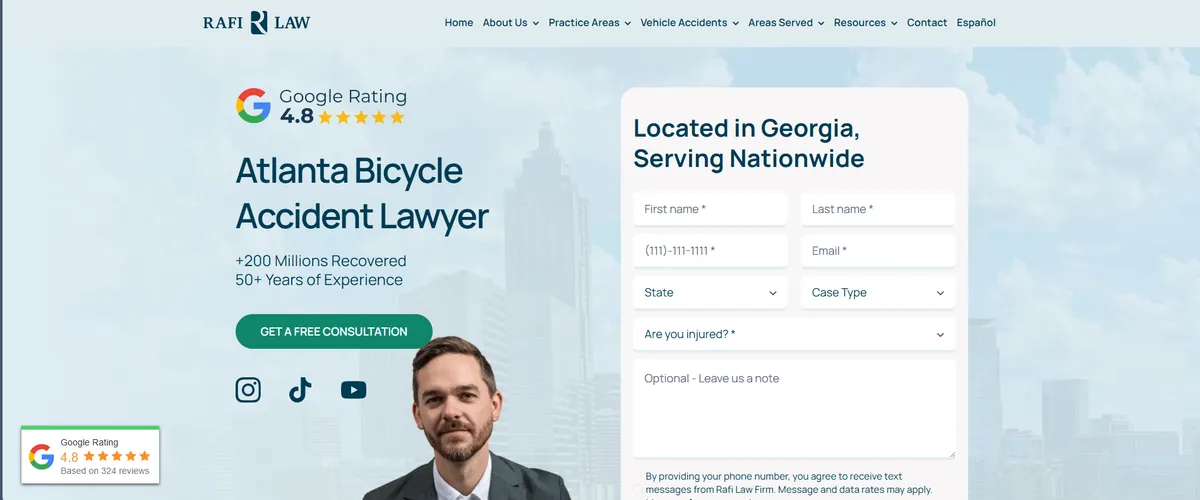
For example Rafi Law's website has a page about bicycle accidents in Atlanta.
This niche practice-area page brings about 330 monthly visits to his website on its own (figure sourced from Ahrefs site explorer).
It is important to end with a concrete next step, a consultation link, a phone number or a form. These pages target high-intent searchers who are close to a decision, they are valuable leads that need to be captured.
Layer two: blog content as satellites
Blog posts are not substitutes for core pages. They function as satellites.
The sequencing matters: build the core pages first, then publish blog content that clusters around them. Google reads that cluster as a signal of topical depth, and that depth is what wins rankings in competitive practice areas.
Core pages convert; blog posts build trust and funnel readers toward those core pages. Get the sequence right and your content starts compounding instead of competing with itself.
04How to Find Topics Your Potential Clients Are Actually Searching For
Keyword research is how you validate which questions people who need your service type into Google and have enough search volume to be worth a full page.
As we cover in our guide to law firm SEO, keyword research for law firms breaks into three tiers, and most firms waste time on the wrong one.
Small firms should focus on long-tail, jurisdiction-specific queries. "Divorce lawyer Chicago" is winnable. "Divorce lawyer" is not. The modifier (a city, a county, a specific circumstance) is what puts the search within reach.
For more information, checkout our complete keyword research strategy for law firms.
Your intake questions are your keyword strategy. Validate them with search data, filter for jurisdiction-specific long-tail terms, and give every distinct question its own page.
05Writing Content That Builds Trust and Earns the Next Step
Once you know which topics to target, the writing itself has to do two jobs: answer the question clearly enough to earn trust, and move the reader toward a concrete next step.
The person landing on your article is not a colleague. They are scared, searching fast, and making a high-stakes decision. Most visitors scan before they commit to reading. Which means every sentence that doesn't earn its place is a sentence that loses the reader.
The conversion chain runs:
Write for a frightened person deciding fast. Plain language, experience over statutes, and one specific next step that names their situation: your content earns the consultation instead of just the click.
06The Real Reason Law Firm Content Efforts Stall (And How to Fix It)
Most law firms publish a handful of posts, go quiet for months, and lose whatever momentum they built. The bottleneck is never expertise or motivation. It is always time.
The fix is not volume. Two genuinely useful, jurisdiction-specific posts per month outperform eight shallow ones. The goal is a pipeline that survives a busy week. That means either blocking time and delegating drafts to a paralegal or writer with attorney review, or outsourcing the full pipeline to a service that models your voice before a single article is drafted. Godaki's done-for-you content engine does exactly that: it captures your voice up front and ships articles on a schedule you approve, so the content builds whether you had a slow week or a brutal one.
Get started with a free onboarding of what makes you the best legal expert your clients don't know they need, and we will show you how to make them aware.
Get my free content engine demo07Measuring What Actually Matters in Law Firm Content Marketing
Once you have a publishing system running, the temptation is to track everything your analytics dashboard shows. Resist it. Page views, social likes, and bounce rate in isolation tell you almost nothing about whether your content is building a client pipeline.
Two signals actually matter for a law firm: qualified leads generated, and which specific content pieces contributed to consultation bookings. Everything else is noise until those two are moving.
Start with Google Search Console, which is free and shows you exactly which queries are bringing visitors to each page. That data tells you which topics to double down on and which to quietly retire. For a faster read on what's blocking your local visibility, run our free law firm website audit.
Review performance every 90 days at minimum. When a page has dropped, update and republish it rather than starting a new one. A single well-updated post on a topic where the law has changed will consistently outperform a fresh article on the same subject, because Google treats freshness as a trust signal for legal content, and rightly so. Build the content, measure the two things that matter, and compound from there.
Law firm content marketing launch checklist
Find out why your expertise isn't generating inbound.
Our free inbound audit breaks down why your content isn't converting and hands you a 90-day content plan built around your practice area, your voice, and the queries your future clients are already typing.